
Electrical Appliances Under New BIS Regulations with a Six-Month Existing Stock Relaxation
BIS Certification for Electrical Appliances is becoming an important compliance requirement for manufacturers and importers in India. A product that was legally manufactured or imported yesterday may face different market requirements today. Changes in Indian product regulations can directly affect sales, distribution and existing inventory. The recent BIS Notification, S.O. 1739(E), dated 6 April 2026, introduces significant compliance obligations under the Safety of Household, Commercial and Similar Electrical Appliances (Quality Control) Order, 2026. From 1 October 2026, covered electrical appliances must conform to IS 302 (Part 1):2024 and bear the BIS Standard Mark under an applicable licence. The notification also provides a six-month relaxation for eligible existing stock, subject to specific conditions. For Indian importers, domestic manufacturers and foreign manufacturers, timely certification is essential.
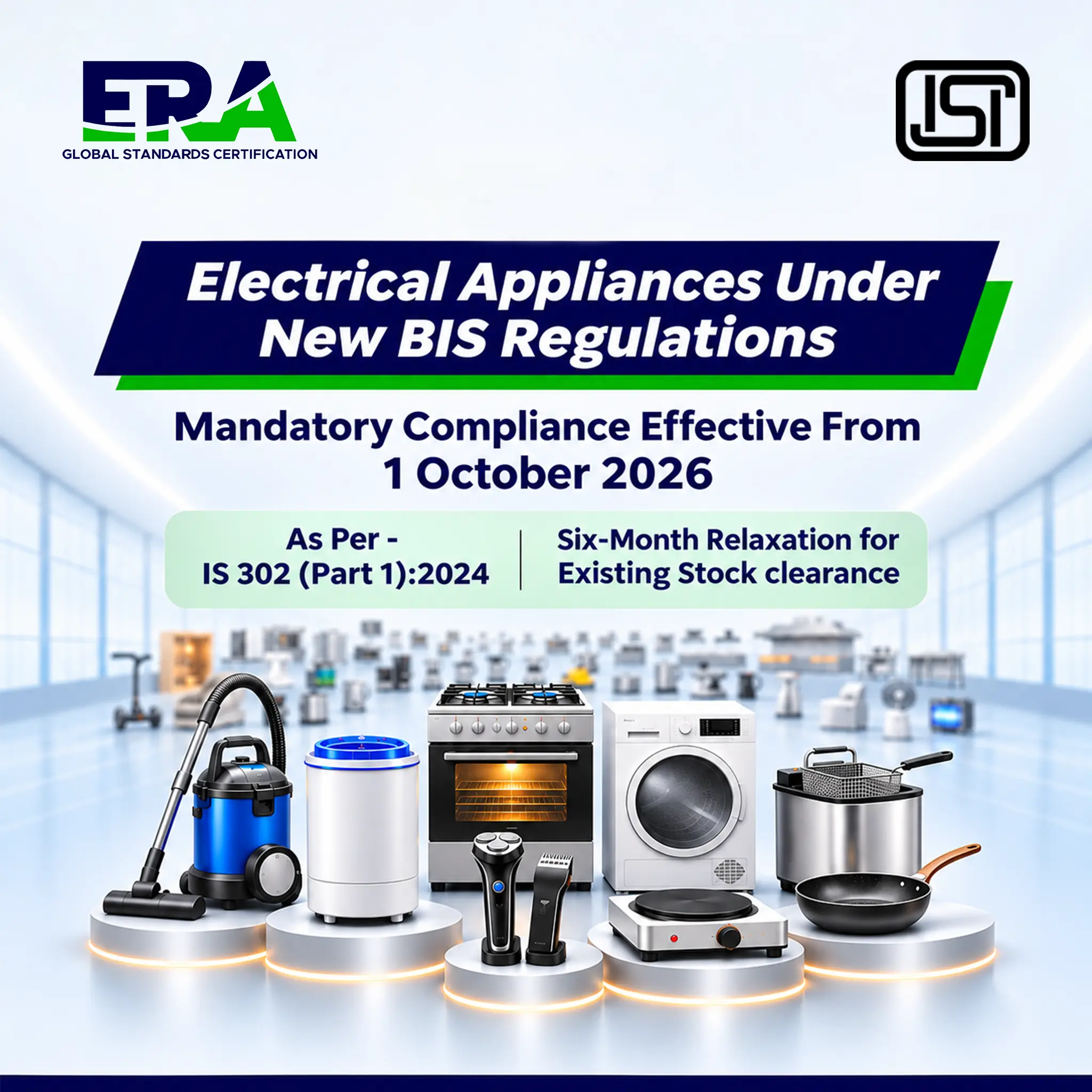
Understanding the New BIS Regulations for Electrical Appliances
The Ministry of Commerce and Industry published S.O. 1739(E) Safety of Household, Commercial and Similar Electrical Appliances (Quality Control) Order, 2026. The order was published in the Gazette of India on 6th April, 2026.
It replaces the order of 2025 and provides for the compulsory requirements for conformity of certain electrical appliances. The applicable Indian Standard is IS 302 (Part 1):2024 based on IEC 60335-1:2020.
Under the order, covered products must conform to the relevant Indian Standard and carry the BIS Standard Mark under a BIS licence issued according to Scheme-I of Schedule-II of the BIS (Conformity Assessment) Regulations, 2018.
The order covers household, commercial and similar electrical appliances with rated voltage not exceeding:
- 250 V for single-phase appliances.
- 480 V for other appliances, including DC-supplied and battery-operated appliances.
However, appliances already covered by another applicable Quality Control Order or notified for mandatory BIS certification under another Act are excluded from this order.
Which Electrical Appliances Are Covered Under the New Order?
The notification contains a list of 90 electrical appliance categories. These cover a wide range of household and commercial products.
Some important categories include:
- Vacuum cleaners and water suction cleaning appliances.
- Cooking ranges, hobs, ovens and electric hot plates.
- Electric shavers, hair clippers and similar appliances.
- Tumbler dryers and dishwashers.
- Electric coffee makers, food processors and juicers.
- Electric water boilers and appliances for heating liquids.
- Commercial cooking equipment, griddles and fryers.
- Air-cleaning appliances and humidifiers.
- Oral hygiene and personal care appliances.
- Battery-operated vacuum cleaners, blenders and air purifiers.
The notification also covers several specialised appliances, including sauna heating equipment, personal e-transporters, electric furniture and commercial vacuum packaging appliances.
The list is not limited to traditional household products. Commercial equipment and selected battery-operated appliances also fall within its scope.
For manufacturers, product classification is important because the applicable compliance obligation depends on the product’s coverage under the notification.
Mandatory BIS ISI Mark Requirement from 1 October 2026
The general implementation date under the 2026 order is 1 October 2026. From this date, manufacturers and businesses dealing with covered electrical appliances must consider the mandatory BIS certification requirement.
Products specified in the notification must conform to IS 302 (Part 1):2024 and carry the Standard Mark under a valid BIS licence.
This requirement is particularly important for businesses involved in BIS Certification in India. Without the required certification, covered products cannot ordinarily be manufactured or imported for sale under the applicable regulatory framework, subject to the exemptions and relaxation provided in the order.
The implementation schedule also provides separate dates for small and micro enterprises:
Business category | Implementation date |
General category | 1 October 2026 |
Small enterprises | 1 January 2027 |
Micro enterprises | 1 April 2027 |
These separate dates are specified in the notification. Therefore, the applicable implementation date depends on the manufacturer’s classification under the MSME framework.
Six-Month Existing Stock Relaxation and Its Conditions
One important feature of the new order is the six-month relaxation for eligible existing stock. This provision recognises that manufacturers and importers may already hold inventory before the implementation date.
Under the notification, the relaxation applies to goods manufactured domestically or imported before the relevant implementation date, provided the manufacturer is already certified by BIS or has applied to BIS for certification of the relevant products.
The manufacturer must also submit a declaration to BIS regarding the existing stock.
Eligible declared stock may be sold, displayed or offered for sale for up to six months from the applicable implementation date.
Who Can Claim the Existing Stock Relaxation?
The relaxation is conditional. It is not a general extension available to every business holding old inventory.
The key conditions include:
- The relevant goods must have been manufactured domestically or imported before the applicable implementation date.
- The manufacturer must hold BIS certification or have applied for certification of the relevant goods.
- The manufacturer must submit the required existing-stock declaration to BIS.
- The relaxation applies for up to six months from the applicable implementation date.
Manufacturers who do not satisfy these conditions cannot claim the existing-stock relaxation under this provision.
This distinction is important for Indian importers and foreign manufacturers. Existing inventory alone does not establish eligibility. The manufacturer’s certification status and declaration are central to the provision.
BIS Certification for Foreign Manufacturers and Indian Importers
Foreign manufacturers supplying electrical appliances to India must pay close attention to the new requirements. Products manufactured outside India are not automatically exempt from mandatory Indian product standards.
BIS Certification for foreign manufacturers in India is an essential part of market entry planning for covered products. The applicable certification framework may include BIS FMCS Certification depending on the product and certification route.
Also, the requirement of a BIS License for Foreign Manufacturers should be considered before products enter the Indian commercial supply chain.
Businesses looking for ISI Mark Certification for Foreign Manufacturers should also know that the certification criteria change depending on the product standard and regulatory notification.
BIS Certification for Exporting to India is thus not just a documentation issue for exporters. It can have an impact on shipment planning, distributor agreements, inventory management and product availability.
There is also a commercial risk for Indian importers when they import products from overseas suppliers without checking their applicable BIS status. Planned shipments and sales commitments may be affected due to delays in certification.
Timely Certification: Why It Matters for Businesses
Certification delays can create problems throughout the supply chain. Manufacturers may have production and inventory issues, and importers might not know when shipments arrive or where the products will be sent.
The six-month relaxation provides little scope to qualify existing stock. But it should not be seen as a replacement for getting the certification you need.
BIS Consultants India will also help businesses understand the broader certification framework and implications of the new order. Similarly, an ISI Mark Consultant in India can explain the relation between applicable Indian Standards and mandatory product marking.
The key issue for companies looking at BIS registration requirements is whether their particular products are covered by the notification and if the necessary certification status is achieved.
Businesses located in industrial and commercial hubs may even face queries regarding BIS Registration Noida, seeking assistance concerning certification. The regulatory obligation is the same, though, regardless of where the consultant is based.
Find out more about this product compliance resource for international product certification and regulatory compliance.
Brand Trust and Compliance with Regulation
BIS certification is an important mechanism to show compliance with the applicable Indian Standards. Electrical appliances compliance can increase confidence among distributors, retailers and consumers.
New requirements also mean foreign suppliers and domestic businesses need to be more aware of regulations. Certification status, implementation date and eligibility under the existing-stock provision may affect the commercial availability of a product.
Non-compliance can lead to serious consequences for your business. The 2026 order says violations are punishable under the Bureau of Indian Standards Act, 2016.
So, businesses should not take the notification as a normal administrative change. It directly affects product conformity, market access and commercial continuity.
Conclusion
The Safety of Household, Commercial and Similar Electrical Appliances (Quality Control) Order, 2026 envisages mandatory BIS certification for specified electrical appliances under IS 302 (Part 1):2024.
If you are an eligible manufacturer, you have some flexibility under the six-month existing-stock relief. But the certification or application for certification, and submission of the required declaration to BIS, are still essential conditions.
For foreign manufacturers and Indian importers, the notification highlights the importance of timely certification and careful inventory planning. Understanding the applicable implementation date and the conditions attached to the relaxation is essential for maintaining compliance in the Indian market.
ERA Global Standards Certification works in the field of product certification and regulatory compliance. Further information is available through www.eraglobal.co.in/contact/