
BIS Certification to Become Mandatory for Wrought Aluminium and Aluminium Alloy Products from December 2026
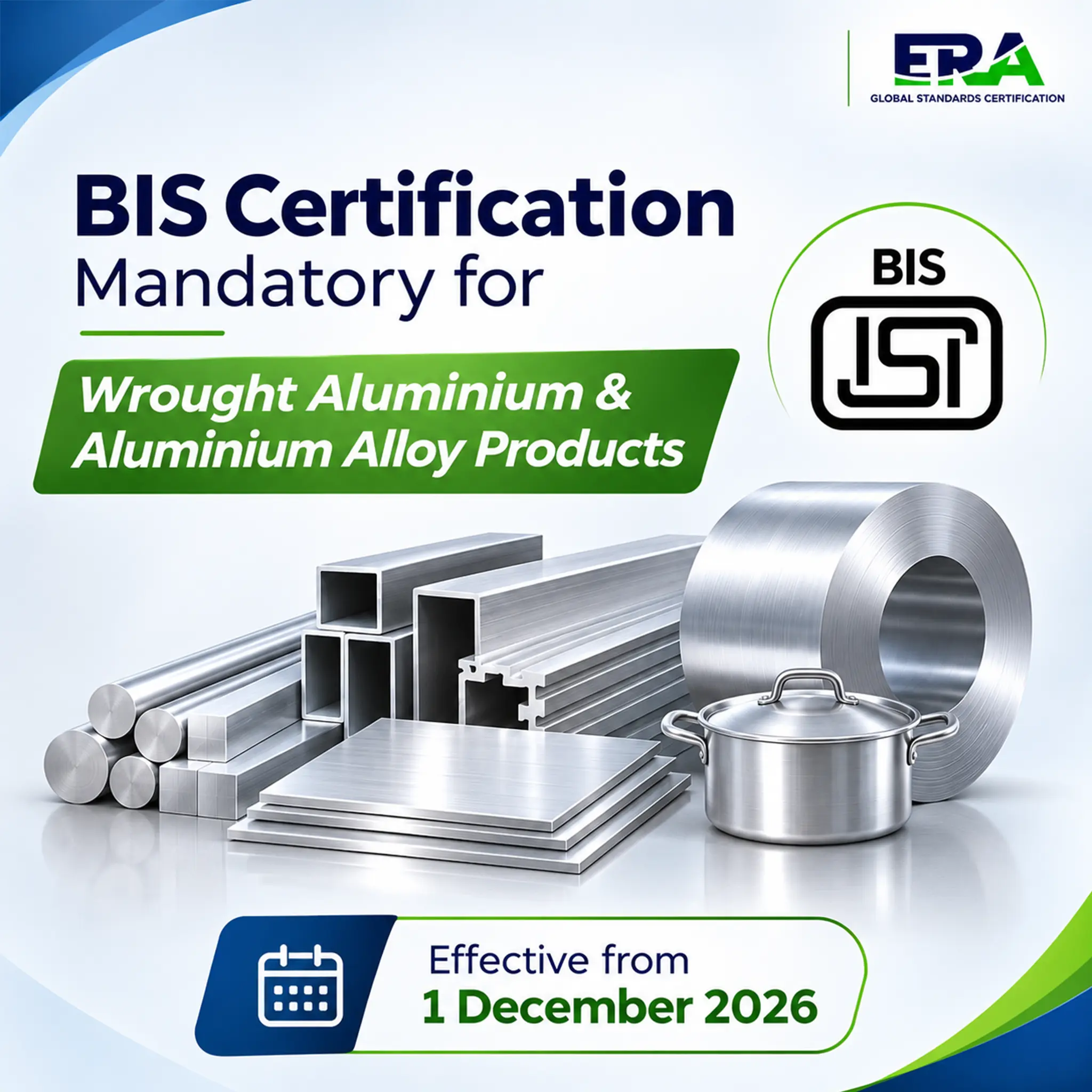
Are your wrought aluminium products ready for upcoming BIS certification requirements? A significant regulatory change is on the horizon for manufacturers supplying aluminium products to the Indian market from December 2026. The latest BIS Notification has made conformity requirements compulsory for selected wrought aluminium and aluminium alloy products used in general engineering and electrical applications. These products are required to conform to their respective Indian Standards and bear the BIS Standard Mark under a valid licence as per the Aluminium and Aluminium Alloy Products (Quality Control) Order, 2026.
The notification lists ten product categories, with the implementation date for general enterprises being December 1, 2026. This change makes BIS Certification for Wrought Aluminium Products an important consideration for domestic manufacturers, importers and international suppliers.
New BIS Notification on Wrought Aluminium Products
The Ministry of Commerce and Industry’s Department for Promotion of Industry and Internal Trade (DPIIT) has issued the Aluminium and Aluminium Alloy Products (Quality Control) Order, 2026.
The order was issued by the Central Government in the Gazette of India on 13 March 2026, through S.O. 1319(E), dated 11 March 2026. It supersedes the former Aluminium and Aluminium Alloy Products (Quality Control) Order, 2025, except for the provisions of the new order.
Under the 2026 notification, specified products must:
- Conform to their respective Indian Standards.
- Carry the BIS Standard Mark.
- Hold a BIS licence under Scheme-I of Schedule-II of the BIS (Conformity Assessment) Regulations, 2018.
The Bureau of Indian Standards (BIS) acts as the certification and enforcement authority. Any violation may attract penalties under the BIS Act, 2016.
Ten Wrought Aluminium Products Requiring BIS Certification from 1 December 2026
The notification identifies ten wrought aluminium and aluminium alloy product categories under specific Indian Standards. For general enterprises, the implementation date for all ten categories is 1 December 2026.
The complete product names and corresponding standards are listed below.
Sr. No. | Product name | Indian Standard |
1 | Wrought aluminium and aluminium alloy bars, rods and sections (For General Engineering Purposes) | IS 733:1983 |
2 | Wrought aluminium and aluminium alloys, forging stock and forgings for general engineering purposes | IS 734:1975 |
3 | Wrought aluminium and aluminium alloy plate for general engineering purposes | IS 736:1986 |
4 | Wrought aluminium and aluminium alloy sheet and strip for general engineering purposes | IS 737:2008 |
5 | Wrought aluminium and aluminium alloy wire for general engineering purposes | IS 739:1992 |
6 | Wrought aluminium and aluminium alloy rivet stock for general engineering purposes | IS 740:1977 |
7 | IS 1285:2002 | |
8 | IS 2067:1975 | |
9 | Wrought aluminium and aluminium alloys for manufacture of utensils | IS 21:1992 |
10 | IS 5082:1998 |
These products serve different manufacturing and industrial applications.
Understanding the BIS Implementation Timeline
The notification provides different implementation dates based on enterprise classification. This distinction is important for manufacturers planning their certification and production activities.
Enterprise category | Implementation date |
General enterprises (other than small and micro enterprises) | 1 December 2026 |
Small enterprises | 1 March 2027 |
Micro enterprises | 1 June 2027 |
The dates apply to the ten product categories listed above.
Consequently, manufacturers should identify their applicable category before interpreting the enforcement timeline. The December 2026 date applies to general enterprises, while eligible small and micro enterprises receive the respective extensions.
Why BIS Certification Matters for Aluminium Manufacturers
Aluminium and aluminium alloys have an important role in modern manufacturing. Industries use these materials because of their strength, low weight, corrosion resistance and flexibility across different applications.
However, product performance also depends on material quality, manufacturing controls and conformity with technical specifications. Mandatory certification creates a common quality framework for the products covered by the notification.
Consistency in product quality
Indian Standards establish technical requirements for specific aluminium product categories. These requirements support consistency and help buyers assess whether products meet recognised specifications.
For example, the ISI Mark for Aluminium Bars and Rods demonstrates conformity with the applicable standard when the product carries the mark under a valid BIS licence. Similarly, certification requirements apply to products such as plates, sheets, wires and tubes.
Greater confidence among industrial buyers
Aluminium products often become components of larger structures, machinery and electrical systems. Their quality can influence the performance and reliability of finished products.
Therefore, certification can strengthen confidence among manufacturers, distributors and industrial procurement teams. It also encourages greater attention to quality across the supply chain.
Effect on Brand Trust and Regulatory Compliance
Product certification is more than just a legal requirement. This can affect a manufacturer’s standing in the market, relationships with suppliers, and customer confidence.
BIS Certification for Aluminium Sheets and Plates is for manufacturers of materials used in engineering and industrial applications. Similarly, the demand for aluminium wires and tubes is significant for companies that serve the electrical and manufacturing industries.
Non-compliance may lead to a variety of business risks:
- Prohibition on sale or supply of covered products.
- Delays in the fulfilment of customer orders.
- Disruption of current supply chain arrangements.
- Additional costs resulting from non-compliance with regulations.
- Penalties under the BIS Act, 2016.
Therefore, certification should be part of the overall strategy of a manufacturer for quality and regulatory compliance.
Importance of Product Certification in Global Trade
International manufacturers often supply aluminium products to many countries. But product approvals and technical requirements may vary from market to market.
The fact that a product meets a foreign standard does not automatically mean that it is compliant with Indian regulations. Exporters should therefore look into the Indian Standards applicable to their products.
The relevance of BIS Certification for Aluminium Alloy Products is particularly important for overseas manufacturers exporting the covered product categories to India. The applicable certification framework helps to establish compliance with Indian requirements.
In addition, product certification can affect relations with Indian importers and industrial buyers. When selecting suppliers and negotiating long-term purchase agreements, regulatory compliance is often a factor for businesses.
BIS Certification Requirements for Overseas Manufacturers
Foreign manufacturers exporting covered aluminium products to India also need to be aware of the applicable BIS certification framework.
For overseas companies intending to market regulated products in India, BIS Certification is an important requirement for foreign manufacturers. Where appropriate, the relevant route to certification is the Foreign Manufacturers Certification Scheme (FMCS).
Also relevant to foreign manufacturers looking at the Indian certification framework are the following terms:
- BIS FMCS Certification: Certification under the Foreign Manufacturers Certification Scheme.
- BIS Licence for Foreign Manufacturers: The licence required under the relevant certification framework.
- BIS Certification for Foreign Manufacturers in India: Compliance with Indian certification requirements for covered imported goods.
- Foreign Manufacturers – ISI Mark Certification: Certification for use of BIS Standard Mark.
- BIS Scheme I Certification: The conformity assessment scheme as specified in the notification.
Foreign suppliers should not assume that certifications issued in their country of origin are a substitute for relevant Indian requirements.
Role of Certification Consultants in Changing Regulatory Environment
There may be questions from manufacturers and exporters regarding the introduction of product-specific certification requirements. When a business manufactures several categories of aluminium products, these concerns can become more complex.
BIS Consultants India helps businesses understand the applicable standards, certification requirements and regulatory documentation. Companies looking into BIS registration should also appreciate the difference between general registration terminology and the BIS licence that is specific to the relevant scheme.
The consultancy services can be found in many locations, such as BIS Registration Noida and other industrial locations for ISI Mark Certification in India. However, the relevant product standard and certification route are still the main considerations.
An ISI Mark Consultant in India can also assist businesses in understanding the regulatory framework for product conformity. Additional information on product certification and regulatory compliance services can provide context for companies looking at their overall certification responsibilities.
Key provisions and exemptions
The 2026 notice also provides for certain exemptions. Such provisions are subject to special conditions.
- Export exemption. The order does not apply to goods manufactured domestically for export.
- Imports of research and development goods: Manufacturers of aluminium products may import up to 200 kg of relevant goods or articles per year for research and development purposes.
- Commercial sale restriction: R&D imports qualifying for the exemption are not allowed to be sold commercially; they must be scrapped.
- Record keeping: The manufacturer shall maintain year-wise records and furnish the requisite information to the Central Government.
These provisions do not establish a general exemption for commercial imports or domestic sales. The notification stipulates conditions which businesses need to consider.
Conclusion
The Aluminium and Aluminium Alloy Products (Quality Control) Order, 2026 introduces important BIS certification requirements for ten wrought aluminium product categories. For general enterprises, the implementation date is 1 December 2026. Small enterprises and micro enterprises have separate implementation dates in March and June 2027.
ERA Global Standards Certification is a technical consultancy covering domestic and international compliance requirements. Further information is available at www.eraglobal.co.in/contact.